top of page
Liberty County Economic Development Study
As a Graduate Research Assistant with Georgia Tech’s Center for Economic Development Research (CEDR), I contributed substantially to a comprehensive economic-development study for Liberty County, Georgia.
My work included demographic and socioeconomic research, peer-community benchmarking, GIS mapping, data visualization, industry and workforce analysis, and written interpretation. I developed the majority of the project’s maps, completed the industry-analysis section using Lightcast, supported the selection and evaluation of peer communities, and contributed to report conclusions and recommendations.
The project examined Liberty County’s population, workforce, industry structure, development conditions, and competitive position to identify opportunities for future economic growth. My role expanded beyond individual data tasks into larger sections of the final report, combining quantitative analysis with spatial context and strategic planning recommendations.
Project type
Economic Development & Strategic Planning
Date
Fall 2025 - Spring 2026
Location
Liberty County, Georgia
Skills & Tools
Economic Development · Strategic Planning · GIS · Lightcast · Industry Analysis · Peer Benchmarking · Demographic Analysis · Technical Writing

01
Liberty County Economic Development Study

01
Building the Peer-Community Framework
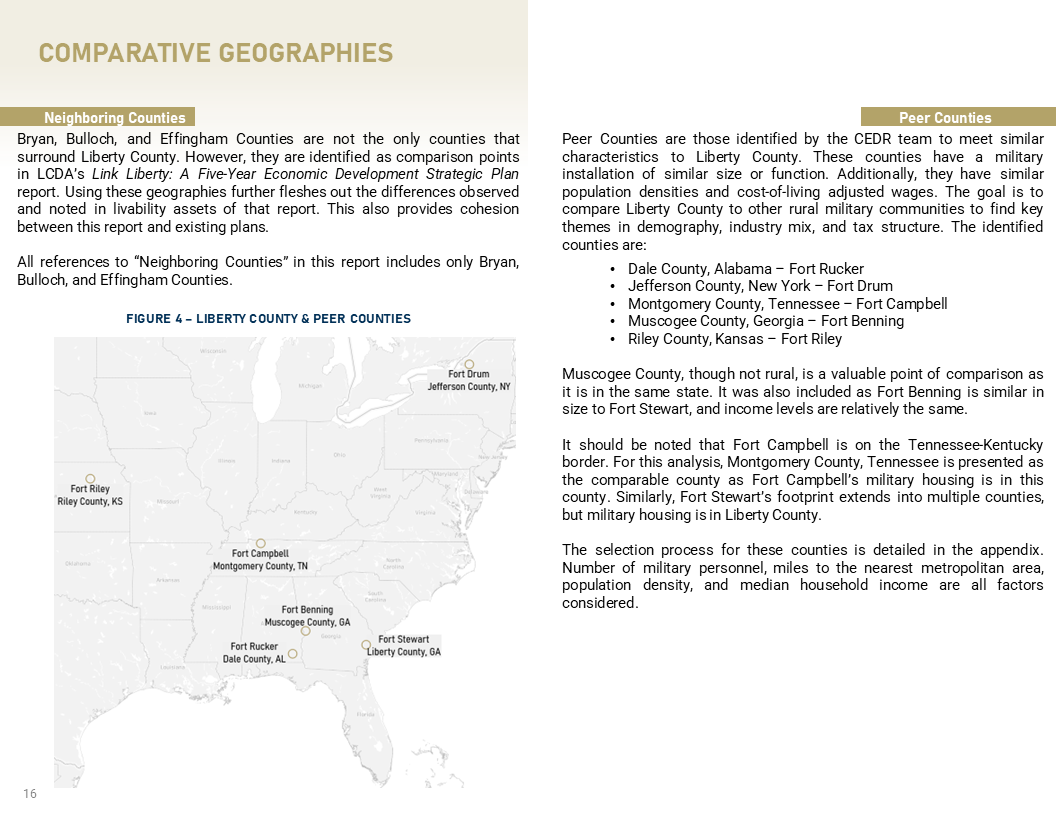
I helped establish the comparison framework for Liberty County by evaluating both neighboring Georgia counties and military-peer communities. The peer set was designed to compare Liberty with places sharing similar military, demographic, density, and economic characteristics rather than relying only on geographic proximity.

02
Liberty County Demographic Profile
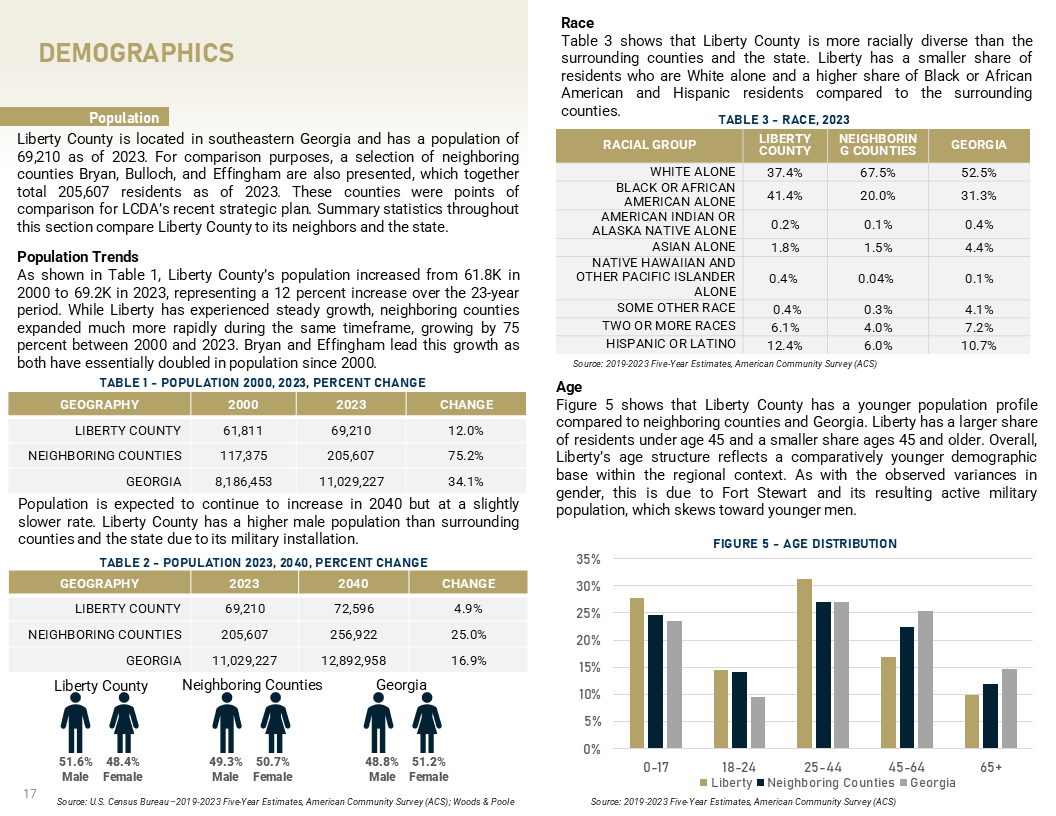
I developed demographic comparisons showing how Liberty County differs from neighboring counties and Georgia in population growth, age, gender, and racial composition. Fort Stewart contributes to a younger and more male-skewed population, creating a distinct planning and economic-development context.

03
Income & Household Economic Resilience
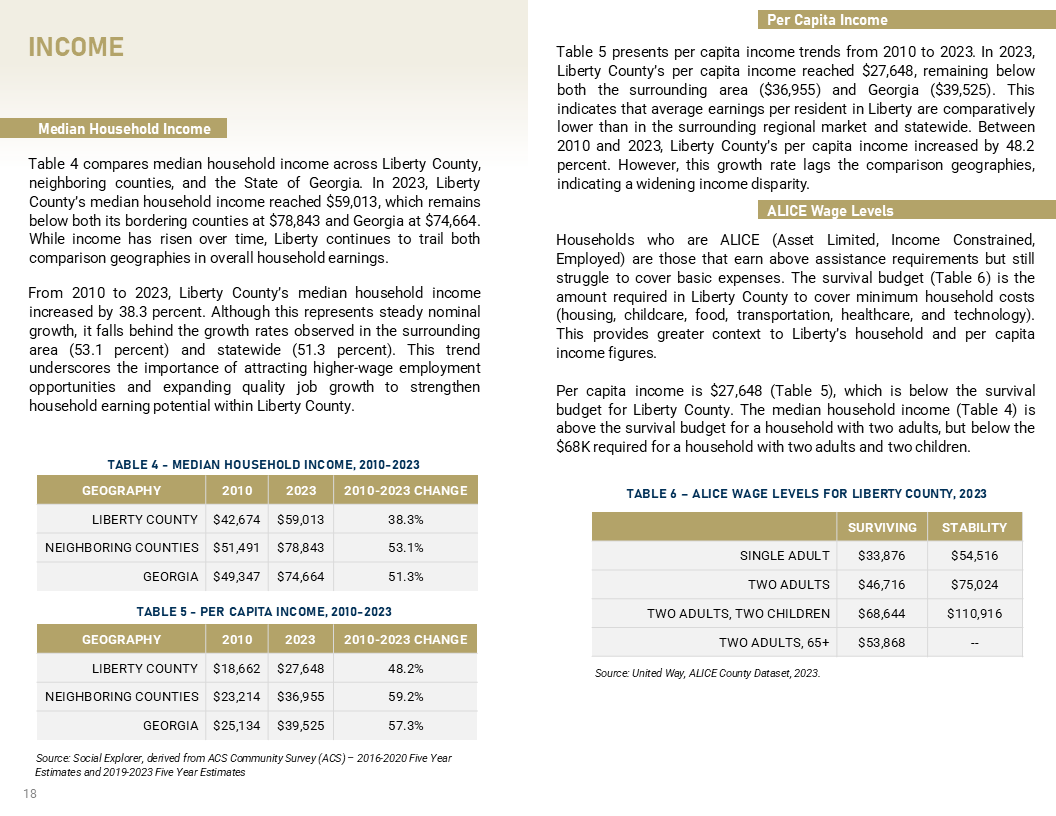
I analyzed household and per-capita income trends and connected them with ALICE survival and stability budgets to provide more practical context for what local incomes mean for household affordability and economic security.

04
Housing Supply & Regional Growth
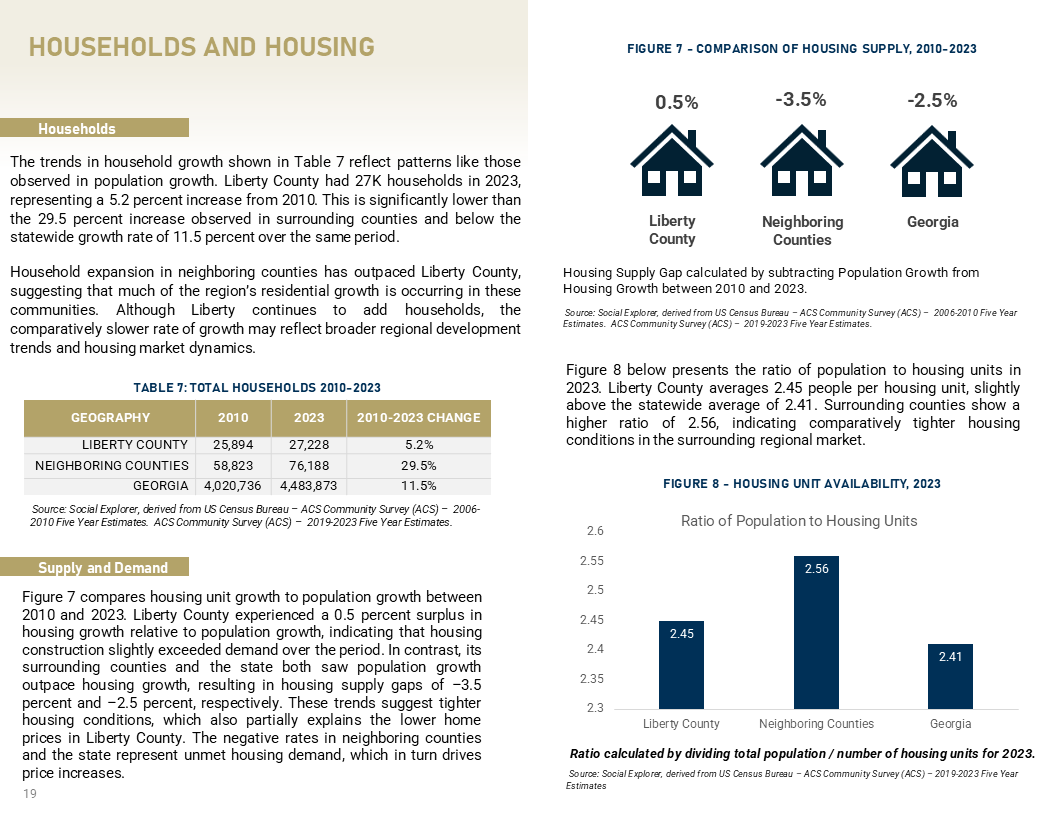
I compared household growth, housing-unit growth, and population change to evaluate whether housing supply was keeping pace with demand. Liberty showed a slightly different pattern from neighboring counties and Georgia, where population growth more clearly outpaced housing production.

05
Housing Tenure & Market Trends
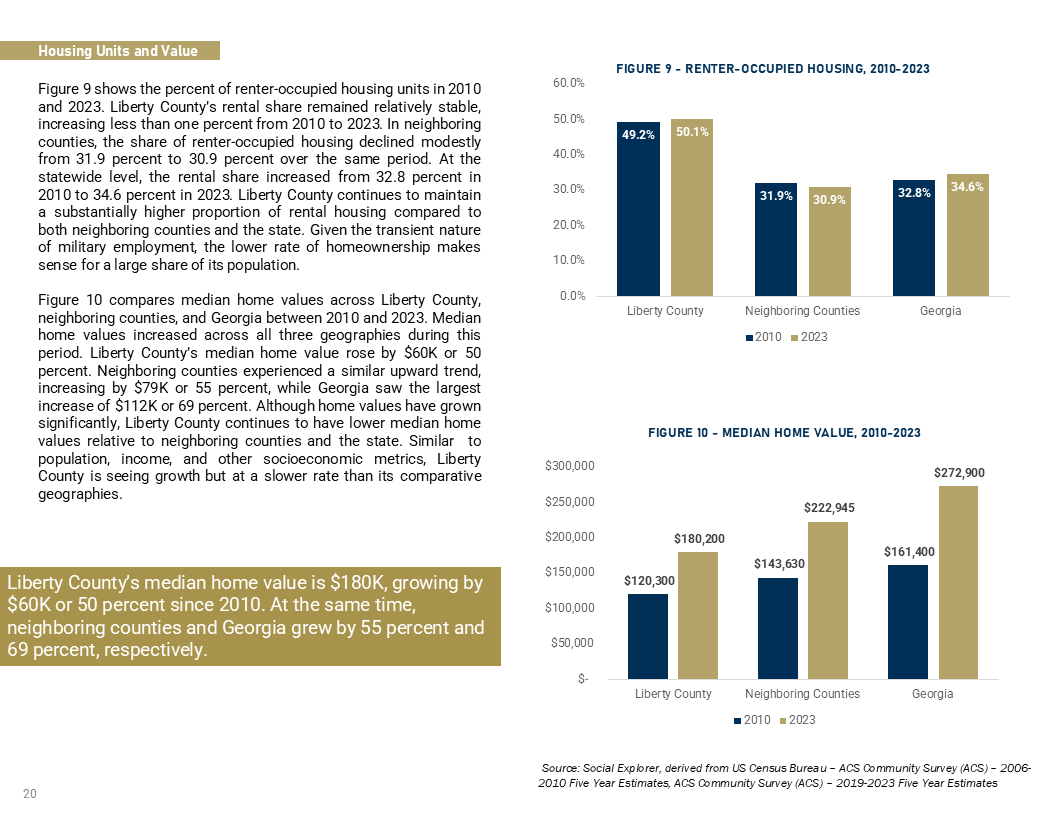
I analyzed rental tenure and home-value trends to understand how Liberty’s housing market differs from surrounding communities. Liberty maintains a much higher renter share, consistent with the mobility associated with a large military population, while home values remain lower than regional and statewide benchmarks.

06
Comparative Community Profiles
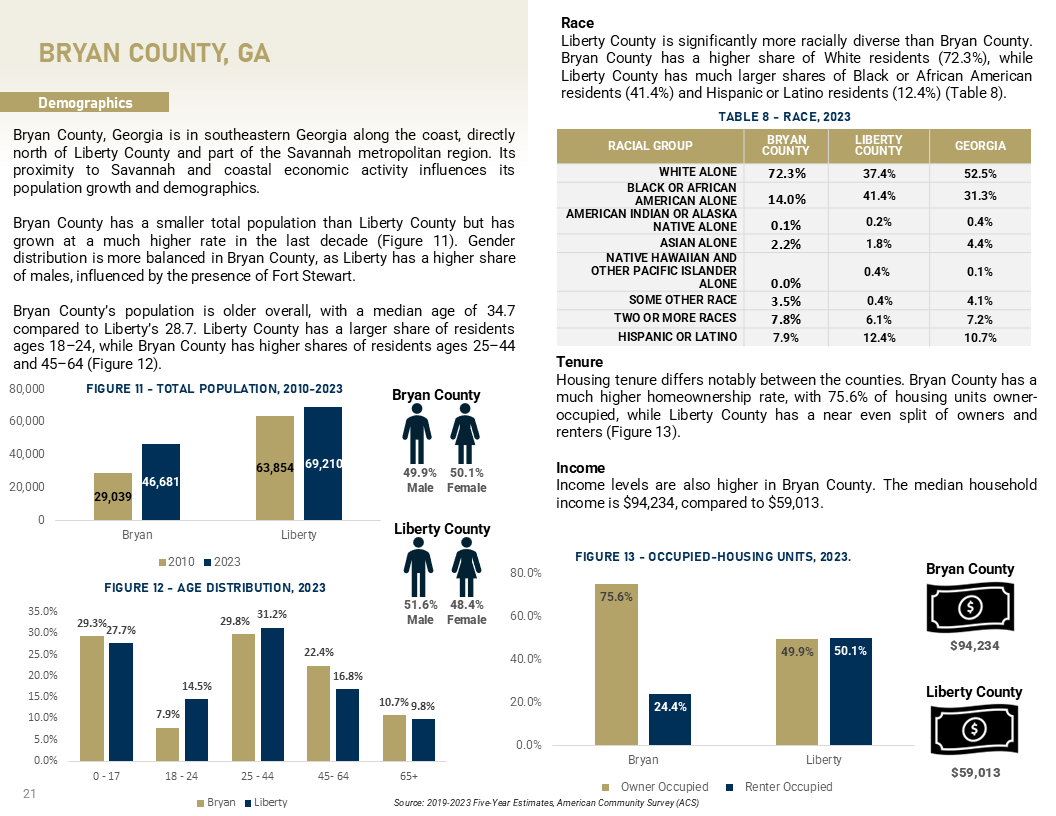
I developed standardized profiles comparing Liberty County with neighboring and military-peer communities across population, age, gender, race, housing tenure, and income. This Bryan County page represents the same analytical framework I applied across the full comparison set.
Comparison geographies analyzed: Bryan County, GA; Bulloch County, GA; Effingham County, GA; Dale County, AL (Fort Rucker); Jefferson County, NY (Fort Drum); Montgomery County, TN (Fort Campbell); Muscogee County, GA (Fort Benning); Riley County, KS (Fort Riley).
Comparison geographies analyzed: Bryan County, GA; Bulloch County, GA; Effingham County, GA; Dale County, AL (Fort Rucker); Jefferson County, NY (Fort Drum); Montgomery County, TN (Fort Campbell); Muscogee County, GA (Fort Benning); Riley County, KS (Fort Riley).

07
Industry Concentration & Economic Diversification
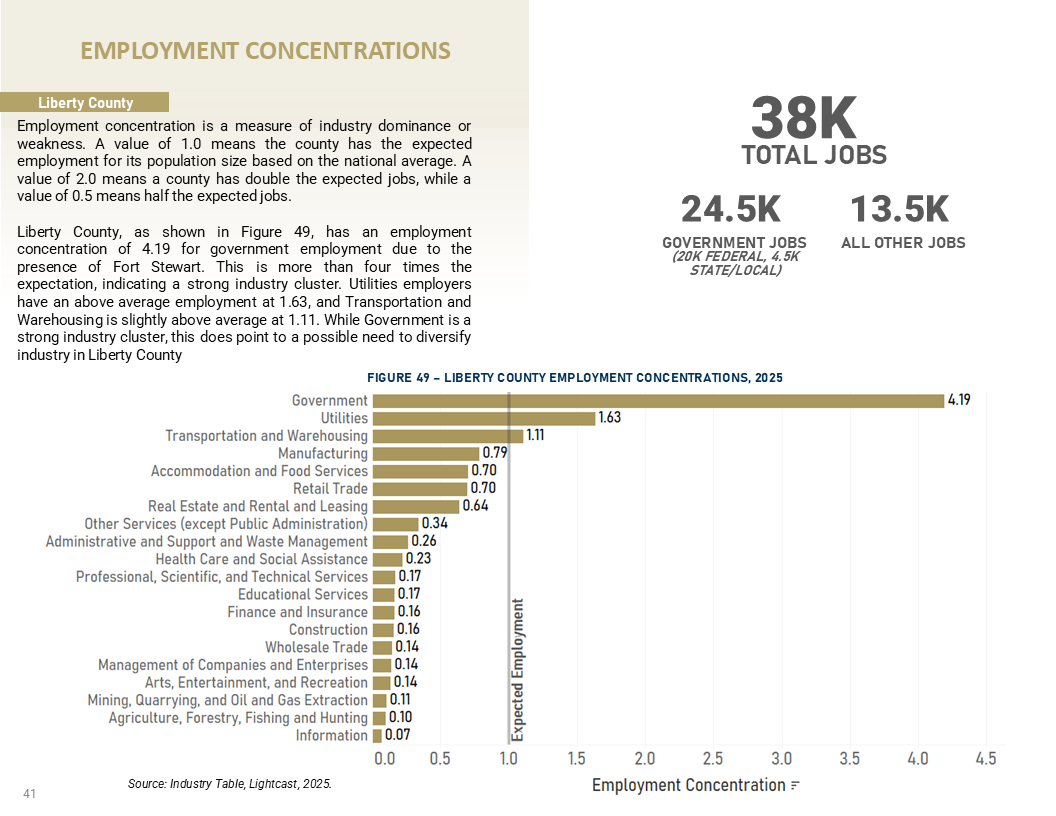
I completed the industry-analysis component using Lightcast employment data and concentration measures. The analysis showed Liberty’s unusually high dependence on government employment, driven largely by Fort Stewart, while most other sectors remain comparatively underrepresented.

08
Comparing Military-Community Economies
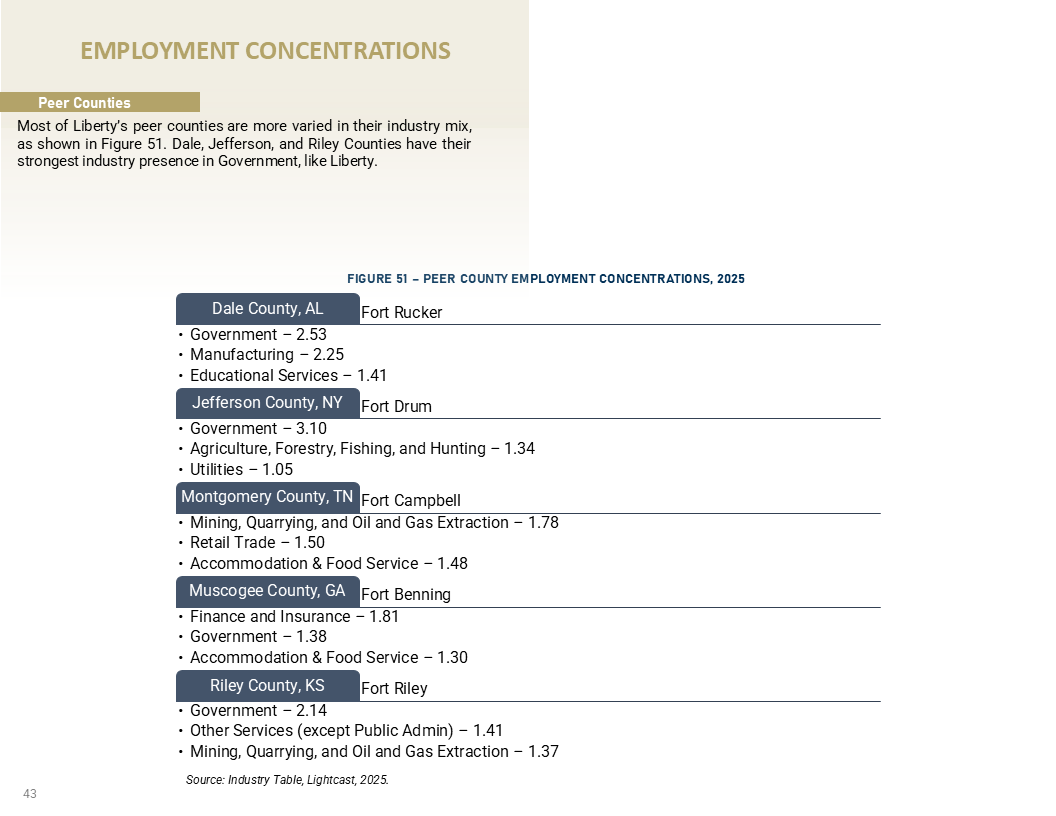
I compared Liberty’s industry mix with other military communities to test whether heavy government dependence was typical. Several peers showed stronger concentrations in manufacturing, finance, education, retail, and other sectors, reinforcing the opportunity for greater economic diversification in Liberty County.

09
Selecting Comparable Military Communities
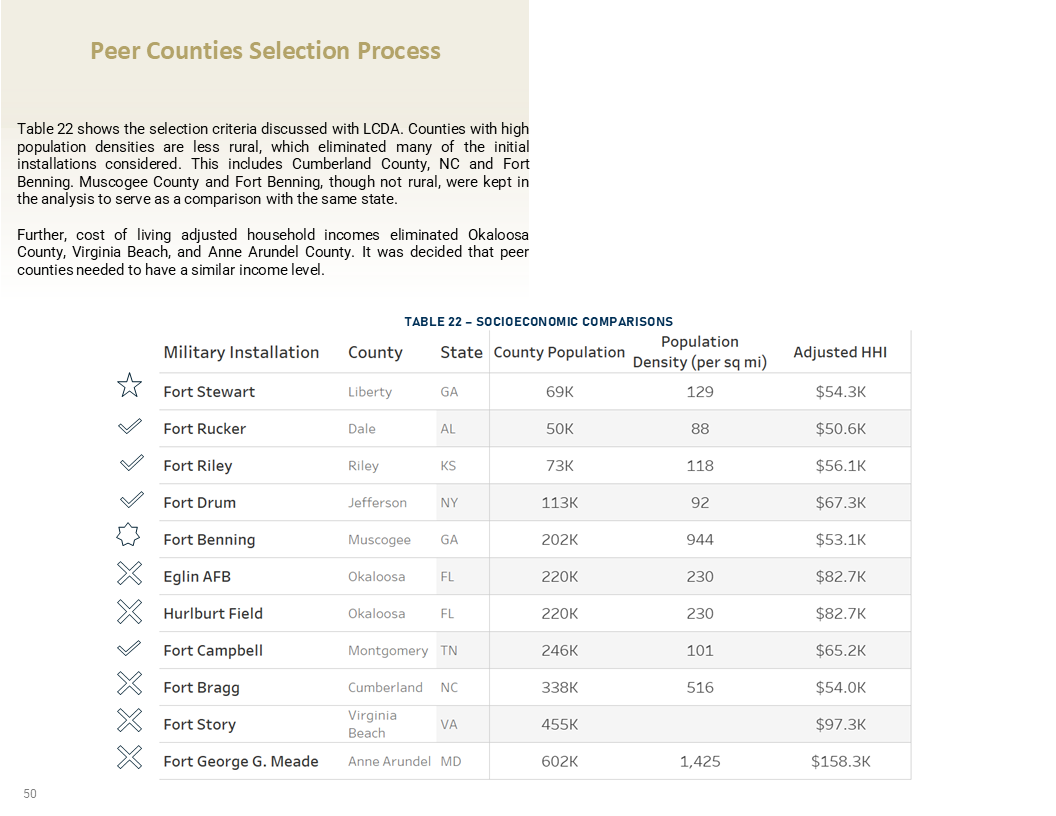
I helped evaluate potential peer communities using installation characteristics, population density, proximity to metropolitan areas, and cost-of-living-adjusted household income. My familiarity with military communities also helped me interpret how installation size, housing, family mobility, and military workforce dynamics can shape local economic and demographic conditions.

10
Translating Analysis Into Strategy
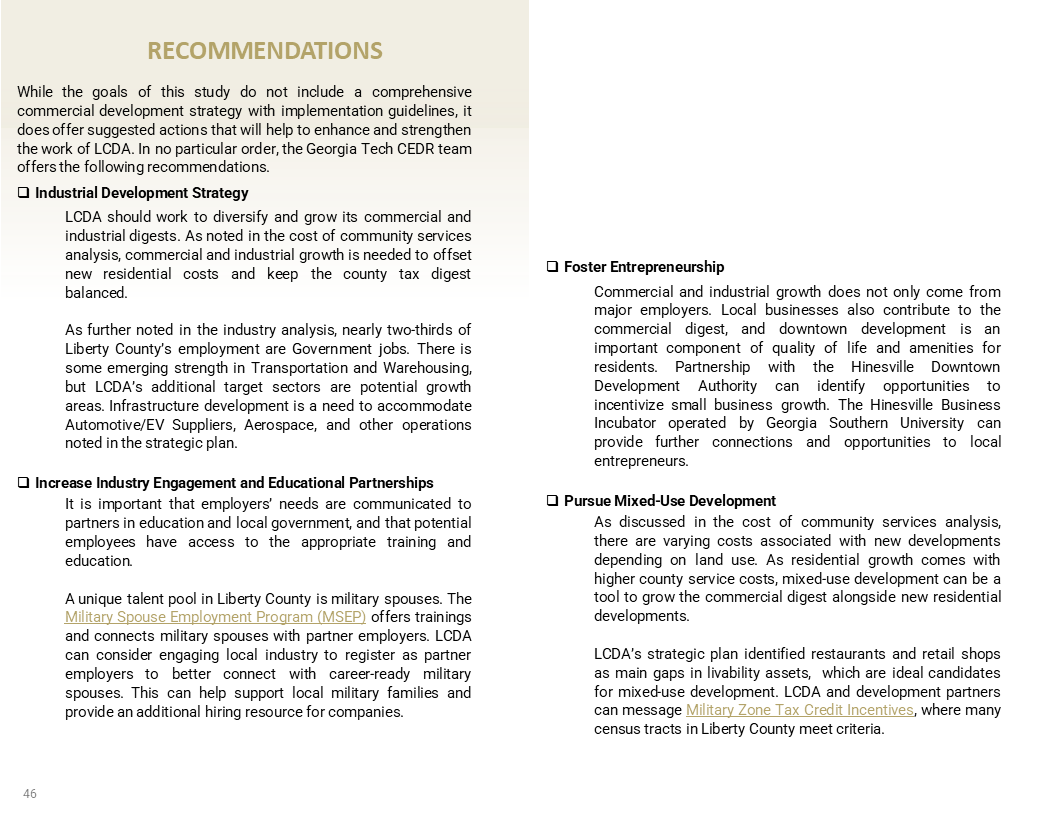
I contributed to discussions that connected the demographic, housing, peer-community, and industry findings to recommendations around commercial and industrial diversification, workforce partnerships, military-spouse employment, entrepreneurship, and mixed-use development.
- Building the Peer-Community Framework
- Liberty County Demographic Profile
- Income & Household Economic Resilience
- Housing Supply & Regional Growth
- Housing Tenure & Market Trends
- Comparative Community Profiles
- Industry Concentration & Economic Diversification
- Comparing Military-Community Economies
- Selecting Comparable Military Communities
- Translating Analysis Into Strategy
bottom of page